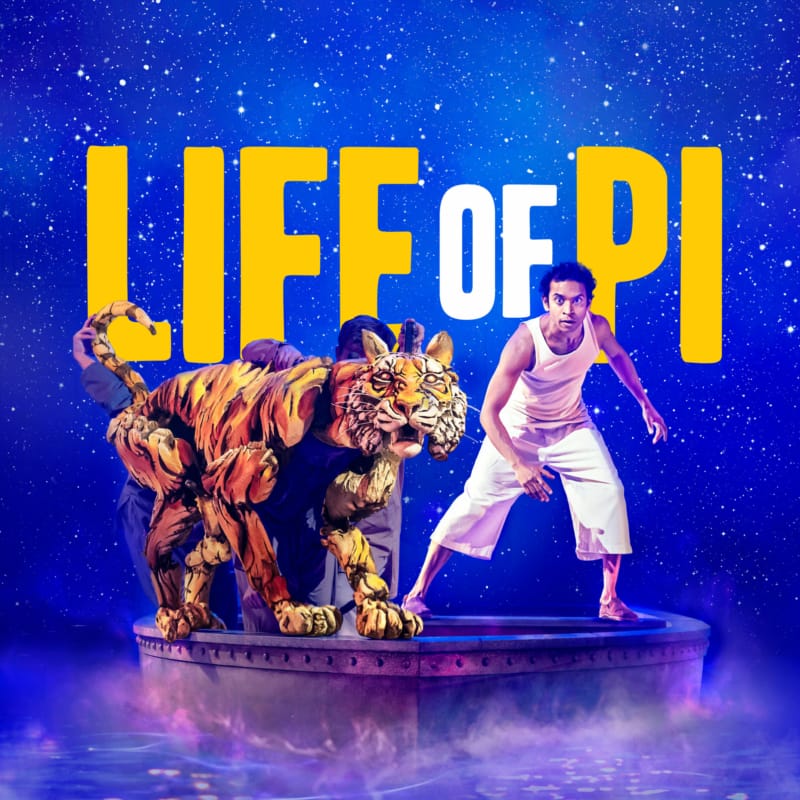
I took my wife to the Hobby Center (Houston) to see The Life of Pi on stage. It was a lovely date night and I’d heard her say a few weeks ago that she loved the movie. It makes me happy to be with her and for her to be happy; all in all, I had a wonderful evening with my Love.
The show, however, I need to parse apart. And not too favorably.
The only reference point I have to the movie is from the first 15 minutes I saw, years ago, where a dispirited reporter character meets with Pi, who seems to be enlightened and confidently asserts that all religions are the same. I won’t get into a religious debate on here, but this kind of pluralism I find intellectually untenable and at the time it annoyed me and I stopped watching.
So I had vague expectations that the story is a fantastical character journey with a vague but accessible spirituality throughout. And a tiger. I wondered if it would become something like the Tim Burton film that my dad and I love, Big Fish. It wasn’t, although the twist and end conclusion of the sort of outside observer character are the same.
The presentation goes from being a very creative and energetic and colorful depiction of village life for Pi and his family in India. I had the impression there would be innovative and enjoyable staging and I was duly impressed in the first act, with the lead actor very dynamically running around the imaginary village which disassembled and reassembled by the use of movable gates and lighting, making the stage feel immersive. The lighting was used even more effectively later when the family boards a cargo ship to leave India and are shipwrecked, which was also depicted in a very brilliant way: the actor and fragments of wood exploded out and suspended by some very strong people beneath them.
The pace was brisk in the first act and the characters established in very broad strokes – it seemed like it was going to be very light fare. The music (prerecorded) was very nice, and the first act ended with an intimation that all the groundwork laid for Pi’s search for God through various religions and the intra-familial tensions of moving from home would somehow stretch all the characters and then resolve.
Basically, what happens is
—–SPOILER ALERT—–
the whole second act is Pi surviving adrift at sea, with his family all gone and just a few animals from the family zoo surviving and killing each other on the raft with him. It turns into a kind of Castaway but with these hallucinatory/spiritual interactions Pi has with his family, mostly to assist in keeping him alive. This half of the play is told through flashbacks as Pi is now in a detention center in Mexico, with some officials trying to get the “real” story out of him, which can’t involve these unlikely animals and situations.
The narrative problems start to multiply in this half. The depiction of him lost at sea became very tiresome (the small boat he lives on being disassembled was interesting only for the first three or so times), but what’s worse is that there truly is no point to this story. It’s just fictional things happening. That might just sound like the definition of fiction, but it’s not really. Why is this story being conceived and told in the first place?
Basically what happens is that after all the fantastical animal goings-on and the apparitions of his relatives telling him basic things like “ration your food”, his version of events is challenged enough by these interviewing officials that he finally tells the real story of his mother surviving only to be murdered and eaten by another survivor. And then Pi killing this murderer. The animals are all stand-ins for the people on the raft but for the famous tiger, Richard Parker (good for a few laughs throughout), who is some sort of visualization of himself.
It ends with the very unempathetic and by-the-book official who originally wants only the “truth” submitting instead this “better” version of the story in his report to his superiors. Basically, the conceit is that this agnostic is converted.
So was it written to inspire? It fails in that because Pi does nothing extraordinary throughout – he has no particular growth in virtue, has no real character at the begging or end and in fact fictionalizes away the horrible the things that happened to him in order to cope. He survives the fictional ordeal and the fantastical nature is subverted at the end by the grisly story detour. There is no inspiration here; there is no “if I were in this situation, I hope I could be that”.
Is it written to endorse faith in the supernatural, a sort of answer to the agnostics? That’s his parting message to the interviewer, anyway. But this Pi character, as I said, has not grown in virtue, and has survived a fictional situation just because the story says so. Not because of his faith. He copes with the horrible things that happened with his fantastical version of events and is near madness at this point…how would any of this convince the interviewer/agnosticism stand-in to accept more than just the ’empirical evidence’ and believe in something higher?
Was the point just to make a whimsical story that also wrestles with something heavier and meaningful at its center, like Big Fish, with it’s considerations of mortality, storytelling itself and father-son relationships? Well, it fails at that too, with the entertaining whimsy being subverted by the truly awful things that actually happened in the story.
The questions presented in the first act – is there a God? Which religion knows him most truly? What should one do to pursue this God? How can a family stay together through change? – are all left unexplored, with an inauthentic ending to wrap it all up. It’s all actually a perfect example of the “and then” storytelling that I mentioned in my previous post.
To put some sort of a personal button on this one: I’m glad that this sort of negative take doesn’t really make me mad like it used to – probably a kind of envy of success on my part – and I really enjoy writing about things I see and listen to, whether it’s positive or negative. Thanks for reading if you made it this far!
Leave a Reply
You must be logged in to post a comment.